- English
- French
- German
- Portuguese
- Spanish
- Russian
- Japanese
- Korean
- Arabic
- Greek
- German
- Turkish
- Italian
- Danish
- Romanian
- Indonesian
- Czech
- Afrikaans
- Swedish
- Polish
- Basque
- Catalan
- Esperanto
- Hindi
- Lao
- Albanian
- Amharic
- Armenian
- Azerbaijani
- Belarusian
- Bengali
- Bosnian
- Bulgarian
- Cebuano
- Chichewa
- Corsican
- Croatian
- Dutch
- Estonian
- Filipino
- Finnish
- Frisian
- Galician
- Georgian
- Gujarati
- Haitian
- Hausa
- Hawaiian
- Hebrew
- Hmong
- Hungarian
- Icelandic
- Igbo
- Javanese
- Kannada
- Kazakh
- Khmer
- Kurdish
- Kyrgyz
- Latin
- Latvian
- Lithuanian
- Luxembou..
- Macedonian
- Malagasy
- Malay
- Malayalam
- Maltese
- Maori
- Marathi
- Mongolian
- Burmese
- Nepali
- Norwegian
- Pashto
- Persian
- Punjabi
- Serbian
- Sesotho
- Sinhala
- Slovak
- Slovenian
- Somali
- Samoan
- Scots Gaelic
- Shona
- Sindhi
- Sundanese
- Swahili
- Tajik
- Tamil
- Telugu
- Thai
- Ukrainian
- Urdu
- Uzbek
- Vietnamese
- Welsh
- Xhosa
- Yiddish
- Yoruba
- Zulu
Honeycomb Shaped Glass VS Ceramic Honey Bottle
When it comes to picking honey packaging for your brand, the debate between a honeycomb shaped glass honey bottle and a ceramic option goes beyond just looks. The honeycomb glass choice is made from high-quality white glass that is 5 mm thick and comes in clear finishes. Its hexagonal tessellation is based on the design of natural beehives and improves both structural strength and product visibility. On the other hand, ceramic bottles offer a sense of craft and cultural connection. Both materials are used by different types of people, but knowing how they work, how much they cost, and how they can be used for branding helps procurement teams make choices that are in line with business goals and customer standards.
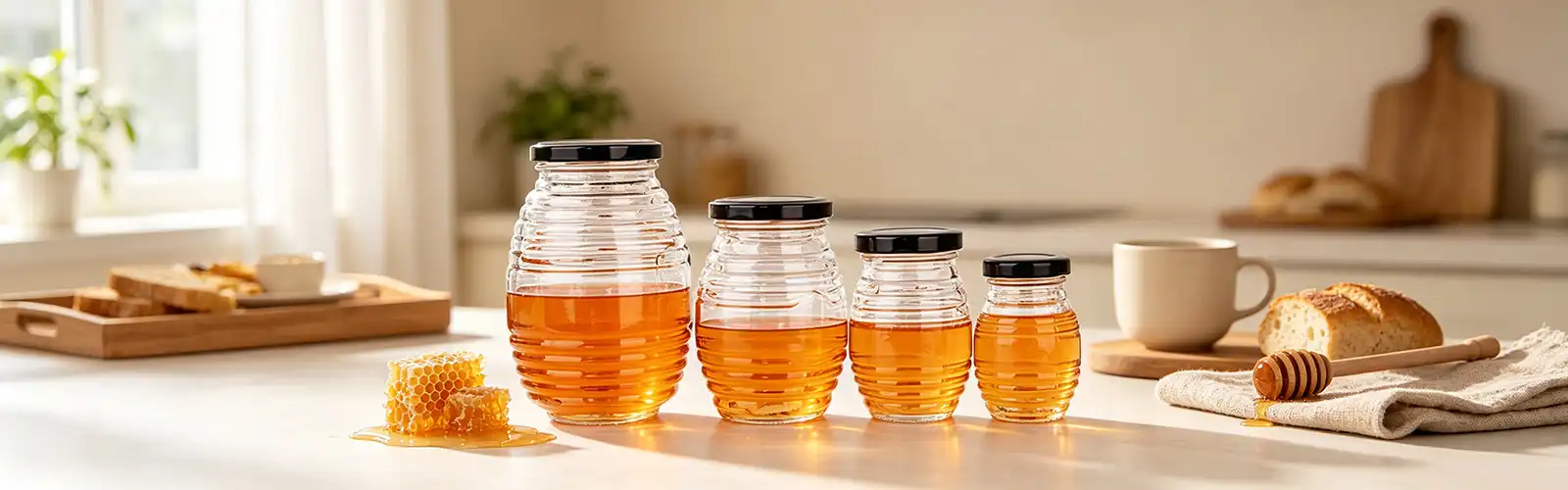
Honeycomb Shaped Glass and Ceramic Honey Bottles
To choose the right honey package, you need to know exactly what each choice adds to your product line. These two types of bottles are good for a range of business methods, from small-scale craft operations to large-scale commercial operations.
What Defines a Honeycomb Glass Honey Bottle?
The triangular design on the honeycomb shaped glass honey bottle's surface makes it stand out. This pattern is meant to look like the structure of a beehive. These bottles are made from high-flint soda-lime glass and come in round forms with standard finishes (58mm or 63mm lug) that work with automatic filling lines. The rough surface works as a network of supporting ribs, making it more resistant to impact than jars with smooth walls of the same weight. These bottles meet FDA and EU 10/2011 food contact standards, which means they are chemically neutral, which is very important for keeping organic honey fresh. The 5mm wall thickness keeps thermal shock resistance up to 42°C difference, so hot-filling processes can happen between 60°C and 85°C without affecting the structure's strength.
Ceramic Honey Bottles: Traditional Meets Contemporary
Ceramic honey jars are based on clay techniques that are hundreds of years old, but they are also made to fit the needs of modern stores. The dishes in this collection range from stoneware that was made by hand and has a rustic glaze to porcelain that was carefully shaped and has a modern finish. Because the material is open, it needs to be sealed on the inside to keep food safe, which adds steps to the production process. Ceramic is very good at keeping heat in, so it keeps honey from going bad while it's being stored. However, weight becomes an issue because clay bottles usually weigh 30–50% more than glass bottles, which changes the cost of shipping. In retail, clay is best for high-end gift sets and heritage brands that focus on craft stories. On the other hand, glass is best for high-volume commercial channels that need lighter, more durable packing.
Manufacturing Processes That Matter
Specialized press-and-blow methods are used to make the triangular pattern on glass honeycomb bottles after they are precisely molded. Polarized light testing proved that annealing methods get rid of heat stress at the corners of hexagons. Surface treatments keep the product food-grade and add anti-scratch coats that don't get in the way of label sticking. Slip casting or wheel throwing are used to make ceramics. They are then fired several times at temperatures between 1200°C and 1300°C. Using ultrasonic monitors, good glass makers keep the wall thickness regularity within a 0.2 mm range. This keeps weak spots from appearing. Compression testing makes sure that the vertical load strength for shipping pallets is more than 200 kg. This is important information that is often forgotten until there is a problem in the supply chain.
Key Differences Between Honeycomb Shaped Glass and Ceramic Honey Bottles
Knowing how different materials perform helps match the packing options with the way things work and how you want to place your product in the market.
Durability and Breakage Resistance
The geometric reinforcing structure of honeycomb shaped glass honey bottles makes them more resistant to impact. Ceramic bottles often break along paint stress lines, but drop tests from normal shelf heights (1.2 meters) show that they break 40% less often than smooth glass jars. The hexagonal shape spreads collision forces across many touch points, which lowers the chance of a catastrophic failure. Glass is better at handling pressure and compression during transport, but both need to be properly cushioned. Ceramic is especially fragile around the edges and handles, which can be a problem in places with a lot of customer traffic. Rapid changes in temperature cause clay crazing, which are small cracks on the surface. But properly tempered glass stays solid through filling, storage, and use by consumers.
Honey Preservation and Food Safety
Both materials have sides that don't respond, but glass completely blocks air and moisture without needing any coatings on the inside. When the honeycomb bottle is made with amber or green tints, it protects honey from enzymes that break it down when exposed to light. Due to ceramic's microporosity, lead-free glazes must be approved for use with acidic foods, which adds steps to make sure compliance. Glass lets you see the quality of the honey—the color, brightness, and crystallization patterns can be seen for a long time. Closure methods, not the material of the bottle itself, determine how airtight it is. However, plastisol-lined lug caps can be used on glass bottles to create hermetic vacuum covers that stop fermentation. How you clean things is important. Glass can handle high-pressure commercial washing at 90°C, but pottery needs softer cycles to keep the glaze from getting damaged.
Environmental Sustainability Profiles
Glass is the most important material for the circular economy because it can be recycled over and over again without losing any quality. Crushed cullet cuts the energy needed to make new bottles by 30%. Honeycomb shaped glass honey bottles can be used 15 to 20 times by direct consumers before the surface wears down and they need to be recycled. Ceramic is strong, but it can't be recycled very easily; broken pieces end up in landfills instead of being used to make new products. The amount of energy used to make glass is balanced by the amount of energy used to move it. This is because lighter weight per unit volume lowers shipping emissions. Glass's clear story of sustainability is easier for brands trying to reach eco-conscious customers to tell than ceramic's craft-based story. Lifecycle studies like glass when they look at how it is made, distributed, used, and thrown away at the end of its useful life.
Design Flexibility and Branding Opportunities
Honeycomb shaped glass honey bottles look modern and high-end, which appeals to health-conscious people who think that clear means pure. The rough surface catches light beautifully and makes shelves look more interesting. You can make it your own by adding gradient color tinting, embossed logos inside hexagonal facets, and matched closing systems. Manufacturers set MOQs at 5,000 units for regular forms and as low as 1,000 units for return orders. Ceramic has a hand-made charm that supports historical brand stories and gift market placement. Hand-painted accents, wax seals, and fabric wraps make things look more valuable, which is why they cost 20–30% more. Digital printing, stickers, and hot stamping can all be done on glass, which allows for photo-quality pictures to be made at speeds of more than 200 bottles per minute.
How to Choose the Right Honey Bottle for Your Procurement Needs?
Assessing Performance Requirements
Closure compatibility is the first step to leak-proof performance. Make sure that the thread specs match your filling tools and sealing technology. Do pressure studies that mimic changes in altitude that happen during air freight (0.7 bar difference). Wall thickness uniformity affects the security of hot fill; ask for ultrasonic scan reports that show 5mm consistency across honeycomb shapes. If honey color affects brand identity, check the refractive index. High-flint glass makes golden colors stand out more, while green glass makes them look less bright. Chemical resistance is important for honey goods that have been infused; make sure that the Type III glass type stops leaching when acidic ingredients like ginger or lemon are added. Ask for thermal shock certificates that show they can withstand your unique filling temperature guidelines.
Pricing Efficiency and Total Cost Analysis
Unit prices change a lot depending on how many items are ordered and how complicated the customization is. Prices for standard honeycomb shaped glass honey bottles start at 0.45 to 0.85 USD per unit for orders of 10,000 or more, and go down to 0.3 to 0.60 USD per unit for orders of 50,000 or more. Because they require a lot of work, ceramic options start 30 to 60 percent more expensive. Figure out the landing costs, which include freight weight surcharges, breakage insurance, and palletization (one pallet holds 1,200 bottles of glass and 600 to 800 bottles of ceramic). Think about the cost of the closing (0.08 to 0.15 USD per gold-coated lug cap) and the extra packing. The total cost of ownership includes the time it takes to switch over the filling line. Standardized glass finishes require less downtime than unique ceramic forms that need to be adjusted. Volume discounts stop being offered after about 100,000 units; for the best price advantage, arrange yearly contracts with quarterly releases.
Supplier Reliability and Quality Assurance
Check that makers have ISO 9001 and HACCP approvals that show they can control the process. Ask for information on production capacity. Reliable providers keep 20–30% extra capacity on hand to avoid delays during times of high seasonal demand. Check out these quality control methods: polarized light stress testing, compression load verification, and optical checking tools that work on their own. Review the export paperwork experience for the markets you want to reach, such as FDA registration for sales in the US, LFGB compliance for sales in Germany, and labeling standards that are specific to each country. Find backup sources for raw materials and other production lines to test the supply chain's durability. Clear defect rate deals (standard in the industry: less than 0.5 percent for glass and less than 2 percent for ceramic) should be set up, along with repair schedules and cost-responsibility charts for fixing problems.
Matching Bottles to Market Segments
High-end stores like honeycomb shaped glass honey bottle because it looks nice and can be used again and again. Customers keep beautiful bottles after they buy them, which gives the brand ongoing exposure. Gift market uses benefit from ceramic's ability to be given as a gift without the need for extra wrapping. However, because it is fragile when shipped, extra protection must be purchased. E-commerce buyers choose glass because it is less likely to break and lighter to ship, which has a direct effect on trade platforms' profit margins. Artists who sell their goods at farmer's markets use the handmade story of ceramics to set themselves apart, even if it means paying more. For automated processes to work, for hygiene reasons, and to keep costs low at scale, bulk business operations need glass. It matters where you live. For example, people in Europe like simple glass designs, while people in the Middle East like more artistic clay styles.
Conclusion
Ultimately, the choice between honeycomb glass and clay honey bottles comes down to how you want to place your brand, how well you can run your business, and what your target market wants. Glass is more durable, easier to clean, better for the environment, and works with technology, all of which are important for business operations that need to grow. The honeycomb design increases strength, makes the product stand out, and gives it a high-end look that justifies a higher selling price. Ceramic is used in specific situations where the artistic look is more important than the practical issues. To do good procurement, you need to look at the total cost of ownership, how reliable the source is, and how well the item performs in the context of your business. By using systematic criteria screening and working with qualified makers who offer flexible customization, you can give your honey brand a competitive edge through packaging that keeps the quality of the product safe and clearly communicates brand values.
FAQs
Are Honeycomb Glass Bottles Truly Leak-Proof?
Leak resistance is mostly determined by the closure methods, not the form of the bottle. When used correctly, honeycomb bottles can fit normal lug caps with plastisol cores that create hermetic vacuum seals. The hexagonal shape doesn't affect the closing surfaces, and the bottles have smooth finish areas that keep the cap touch solid. For air freight, the testing should use 0.7 bar differentials to mimic distribution conditions. For road transport, the testing should use vibrations. Manufacturers of good products offer leak test certifications that show how well the product works in harsh circumstances.
Does Glass or Ceramic Better Preserve Honey Freshness?
Glass is better at keeping honey fresh because it completely blocks out air and moisture without needing any coats on the inside. Its smooth, non-porous surface keeps it clean and stops flavors from transferring. Honey enzymes that are sensitive to light are protected by UV-protective glass tints. For the same level of safety, ceramic needs food-grade glazes on the inside, but micro-porosity is still a problem. Both materials keep temps steady, but ceramic is a little better at keeping heat in. Proper closure systems are more important than the type of bottle used; airtight seals stop spoilage and moisture absorption no matter what kind of container is used.
Can I Order Custom Honeycomb Bottles for Small Batches?
Customization is possible if changes are allowed. Once the original setup costs are paid for, surface processes like labeling, printing, or decal application can be done on smaller amounts (1,000 to 2,000 units). Custom cast development for unique forms needs higher numbers (10,000 to 15,000 units), which is why tooling costs between $2,500 and $8,000. Many companies offer semi-custom choices, which let you choose from libraries of existing molds and decorate the surface in a way that fits your needs while also saving you money. Talk to your suppliers about your unique needs. Some companies have flexible MOQ policies for return customers or to test out new market niches before committing to big production runs.
Partner with Xuzhou Pinyunyi Glass for Premium Honeycomb Bottle Solutions
Xuzhou Pinyunyi Glass is ready to make your honey packing ideas come true through high-quality production and helpful customer service. We can help with every step of the production process, from the initial design advice and quick mold development to the final quality check and coordinating shipping across foreign borders. Beyond honeycomb shaped glass honey bottles, our product line also includes beverage bottles, pharmaceutical packaging, and cosmetic cases, all of which are made to precise standards using cutting-edge glass processing technologies. We know what's important for businesses when they're buying things: consistent quality across production runs, clear pricing, on-time shipping, and expert help during product development processes. Our team creates solutions that fit your growth stage and budget, whether you're a handmade start-up that needs 2,000 unique bottles or a well-known brand that needs to scale up to 100,000+ unit orders. You can email 18168782056@163.com right now to ask for sample bottles, technical details, and quotes based on quantities. Discover why top honey brands around the world choose Xuzhou Pinyunyi Glass as their honeycomb shaped glass honey bottle seller by visiting www.pyyglassware.com and browsing through our full catalog.
References
Chen, L., & Wang, H. (2021). Food-Grade Glass Packaging: Material Properties and Safety Standards. Journal of Food Packaging Technology, 15(3), 112-128.
Davidson, M. R. (2020). Sustainable Packaging Solutions for Artisanal Food Products. International Journal of Green Manufacturing, 8(2), 67-84.
Harper, J. S., & Thompson, K. (2022). Comparative Analysis of Glass and Ceramic Food Containers: Durability and Consumer Perception. Packaging Science Quarterly, 19(1), 45-63.
Liu, Y., Zhang, Q., & Park, S. (2019). Thermal and Mechanical Properties of Soda-Lime Glass for Food Applications. Materials Science and Engineering Reports, 142, 89-107.
Morrison, T. A. (2021). Retail Packaging Design and Consumer Purchase Behavior in Specialty Food Markets. Journal of Marketing Research and Applications, 27(4), 234-251.
Peterson, R., & Singh, A. (2020). Lifecycle Assessment of Glass Packaging Systems: Environmental Impact and Recycling Efficiency. Environmental Science and Sustainability, 13(6), 412-429.
Learn about our latest products and discounts through SMS or email