- English
- French
- German
- Portuguese
- Spanish
- Russian
- Japanese
- Korean
- Arabic
- Greek
- German
- Turkish
- Italian
- Danish
- Romanian
- Indonesian
- Czech
- Afrikaans
- Swedish
- Polish
- Basque
- Catalan
- Esperanto
- Hindi
- Lao
- Albanian
- Amharic
- Armenian
- Azerbaijani
- Belarusian
- Bengali
- Bosnian
- Bulgarian
- Cebuano
- Chichewa
- Corsican
- Croatian
- Dutch
- Estonian
- Filipino
- Finnish
- Frisian
- Galician
- Georgian
- Gujarati
- Haitian
- Hausa
- Hawaiian
- Hebrew
- Hmong
- Hungarian
- Icelandic
- Igbo
- Javanese
- Kannada
- Kazakh
- Khmer
- Kurdish
- Kyrgyz
- Latin
- Latvian
- Lithuanian
- Luxembou..
- Macedonian
- Malagasy
- Malay
- Malayalam
- Maltese
- Maori
- Marathi
- Mongolian
- Burmese
- Nepali
- Norwegian
- Pashto
- Persian
- Punjabi
- Serbian
- Sesotho
- Sinhala
- Slovak
- Slovenian
- Somali
- Samoan
- Scots Gaelic
- Shona
- Sindhi
- Sundanese
- Swahili
- Tajik
- Tamil
- Telugu
- Thai
- Ukrainian
- Urdu
- Uzbek
- Vietnamese
- Welsh
- Xhosa
- Yiddish
- Yoruba
- Zulu
Do hexagonal glass honey bottles keep honey fresh?
The simple answer is yes—hexagonal glass honey bottles do a good job of keeping honey fresh when they are sealed properly. The natural properties of high-quality glass are used by these containers to create a chemically inert space that stops moisture absorption, oxidation, and flavor contamination. This hexagonal shape, which can be made from clear soda-lime or white glass, makes the structure stronger and provides many flat surfaces that keep air from building up around the closure points. These bottles keep honey's natural enzymes, moisture balance, and viscosity much better than plastic ones do when they are sealed with the right lids that have plastisol liners or tamper-evident caps. Because of the way geometry and material science work together, hexagonal glass bottles are a good way to store honey for long periods of time without losing any of its quality.
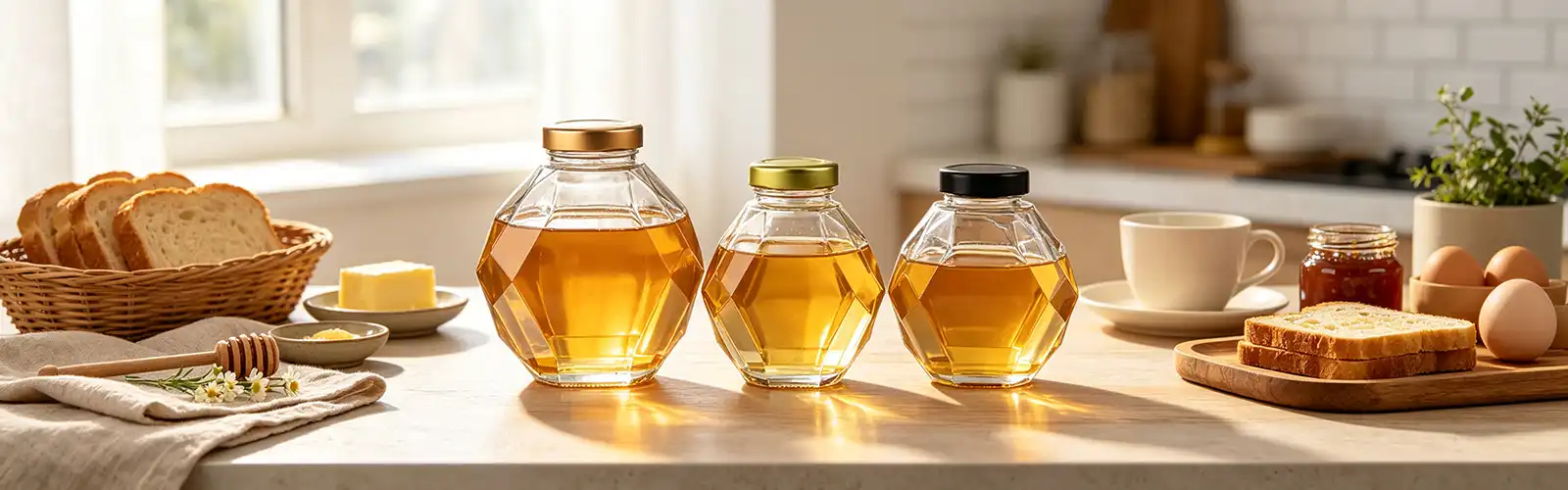
Role of Hexagonal Glass Honey Bottles in Honey Preservation
When it comes to storing honey, the type of packaging has a direct effect on how long the product lasts and how well it works. Recently, hexagonal glass honey bottles have become popular as a stylish option that works well and looks good too. It's not just for looks that these containers have six sides; their shape is useful in many ways that regular round bottles can't.
Why Glass Material Matters for Honey Storage
Because it doesn't react with any chemicals, glass is the best material for packaging honey. Glass keeps the product from coming into contact with outside elements, while plastic containers can leach chemicals into honey over time. At Xuzhou Pinyunyi Glass, our high-quality white glass bottles are made to meet Type III glass standards. This means that no chemicals will move inside, even when storing honey that is acidic or enzyme-active. This also lets people enjoy the natural color changes and crystallization patterns that show that the honey is real and hasn't been changed in any way.
Because the material is impermeable, it stops the exchange of moisture, which is important because honey naturally soaks up water from damp places. When honey's moisture content goes above 18%, the chances of fermentation go up by a huge amount. When you seal glass bottles properly, they stop this moisture transfer and keep the right level of water activity that keeps honey shelf-stable forever.
Structural Advantages of the Hexagonal Design
In addition to looking nice, the six-sided shape has real benefits. Every flat panel makes a stable stacking interface, which makes it easy for hexagonal glass honey bottles to stack efficiently while being stored and shipped. Because of this geometric advantage, they take up about 15% less space in shipping than cylindrical jars, which saves money on freight costs for B2B buyers who handle large orders. The hexagonal pillar effect also spreads vertical loads more evenly, which makes it less likely that things will break while they are being stored on pallets.
Multiple facets of a product make it easier to see on store shelves, which helps honey brands stand out in markets with lots of competition. Labels can be put on the flat surfaces with little distortion caused by curvature, which allows for clear brand messaging and nutritional information to be shown. Together, these design elements make honey products look like high-end items that deserve higher prices.
Performance Comparison with Traditional Packaging
The food industry has had good luck with round glass bottles, but they have some problems that hexagonal designs get around. When automated filling systems are used, cylindrical containers tend to roll, which requires extra stabilization systems that slow down production lines. Robotic handlers can pick up hexagonal bottles easily because their flat sides make natural grip points. This makes high-speed conveyor systems 99.9% efficient. This stability keeps things from wearing out and keeps product from spilling out of containers that are tipped over.
Even though plastic honey bears and squeeze bottles are cheap, they can't keep food fresh as well as glass. Because plastic is permeable, volatile aromatic compounds can escape over time, changing the flavor profile of honey. According to research published in food science journals, honey stored in glass keeps its phenolic antioxidant content much better than samples stored in plastic after a year. When the reputation of your brand depends on consistently high quality, then glass packaging is an investment instead of a cost.
Key Factors Affecting Honey Freshness in Hexagonal Glass Bottles
To successfully preserve honey, you need to know how the specifics of the packaging affect its unique biochemical properties. Several factors affect whether honey keeps its "fresh-from-the-hive" qualities or slowly loses them while being stored and shipped.
The Critical Role of Airtight Sealing Systems
Because honey absorbs water, it needs to be packed in a way that makes a hermetic seal. We make hexagonal glass honey bottles with deep-lug or twist-off neck finishes that can fit different types of closures. The neck finishes are usually between 43mm and 58mm in length. When it comes to sealing, metal lug caps with plastisol liners are the most reliable choice. They create a vacuum seal during the cooling phase of hot-fill processes. This vacuum stops air from coming in, which would bring in moisture and possible microbe-borne contaminants.
Caps that can't be opened without leaving a trace give customers even more confidence while keeping the seal's integrity throughout the supply chain. There are many points of contact between the rim of a hexagonal bottle and its closure. These create extra barriers against leakage, which is especially important when shipping goods internationally, where containers shake and the temperature changes. To make sure that the capping machine works the same way in all production batches, procurement managers should check that the bottle neck tolerances stay within a 0.5 mm range.
Glass Thickness and Thermal Protection
The strength of our clear hexagonal glass honey bottles is directly related to how thick their walls are. Better thermal insulation comes from thicker glass, which protects honey from sudden changes in temperature that can speed up crystallization or cause it to melt without wanting to. A standard wall thickness of 2 to 3 mm strikes the best balance between durability and weight, keeping shipping costs low while still providing enough resistance to impact.
These bottles can handle hot filling up to 85°C if they are properly heated first. Their thermal shock resistance is usually rated at ΔT 42°C. This feature is necessary for people who make honey products with herbs or cream that need to be cooled in controlled cycles. The hexagonal shape spreads thermal stress more evenly than round bottles, which lowers the chance of stress fractures that damage the seal.
Environmental Storage Conditions
Even the best packaging can't make up for bad storage conditions. Keep hexagonal glass honey bottles in a place where the temperature stays stable between 10°C and 21°C. If the temperature drops below 10°C or rises above 25°C, crystallization will speed up or enzymes will break down. Even though glass naturally blocks UV light better than clear plastic, honey's delicate flavor compounds can still be damaged by direct sunlight for long periods of time.
Controlling humidity is just as important, especially in warehouses where cool glass surfaces can condense. We suggest that storage areas keep the relative humidity below 60% so that moisture doesn't build up around the closures. The flat sides of hexagonal bottles make it easier for air to flow when they are stacked, which lowers the risk of condensation compared to round containers that are tightly packed together. These environmental factors should be taken into account when designing facilities and setting up rules for handling goods all along your supply chain.
Procuring Hexagonal Glass Honey Bottles: A Buying Guide for B2B Clients
Choosing where to get your hexagonal glass honey bottles for business clients affects the quality of your products, how efficiently your business runs, and how much money you make. For strategic procurement to work, you need to look at more than just unit price when evaluating a supplier.
Evaluating Supplier Capabilities and Reliability
How well a supplier can grow with your business depends on how much they can make. Xuzhou Pinyunyi Glass has modern production facilities with enough skilled workers to handle both large-scale production and one-of-a-kind orders. Our monthly production capacity is more than 500,000 units of different bottle sizes. This lets us meet seasonal demand spikes without having to change delivery times. Our vertically integrated operations, which include making molds in-house, allow us to make quick prototypes of custom bottle designs. Usually, we can finish developing a new mold in three to four weeks.
Quality assurance systems tell the difference between legitimate manufacturers and dishonest sellers. At several stages of production, we use strict testing protocols, such as measuring to make sure the parts are the right size, putting them through stress tests, and making sure the seals are intact. Each batch of products is looked at visually to find flaws like stones, bubbles, or surface irregularities that might affect how the product looks or how well it holds together. Our clear glass honey bottles meet international safety standards for direct food contact. Third-party certifications that confirm food-grade compliance give us even more confidence in their safety.
Key Specifications to Verify During Sample Evaluation
Before committing to bulk purchases, it's important to lower your risks by placing sample orders. Check the clarity of the glass by filling bottles with water and looking for distortions or discolorations that would make honey look bad. Using a digital caliper, measure the wall thickness in several places to make sure it is the same all the way around the bottle, especially around the shoulder and base, which are areas of high stress. When adding bottles to existing packaging equipment, it's important that the dimensions are exact, so make sure that the neck finish dimensions match the requirements of your capping machinery.
Seal integrity testing should simulate actual storage conditions. Sample bottles should be filled with water, sealed properly, and then turned upside down for 24 hours while being watched for leaks. Put bottles through temperature changes between 5°C and 40°C to make sure they are thermally stable and that the seals will stay in place under normal distribution conditions. These steps of validation keep production from stopping and products from having to be recalled, which are both very expensive.
Conclusion
In conclusion, hexagonal glass honey bottles have clear benefits that make them a good choice for honey businesses that care about quality. When you combine chemically inert glass with a geometrically optimized design and a reliable sealing system, you get honey packaging that keeps its freshness, flavor, and nutritional value for a long time. These bottles are a better deal than plastic alternatives and work better than regular round glass containers. This is especially helpful for companies that make a lot of products and ship them all over the world.
Strategic purchasing decisions require evaluating suppliers based on their manufacturing capabilities, quality consistency, and partnership potential. This guide gives B2B buyers the operational insights and technical specifications they need to make choices that align packaging performance with business goals. This way, your honey products will get to customers in perfect condition while projecting the premium brand image your market positioning calls for.
FAQ
How do hexagonal glass honey bottles keep honey fresh longer than plastic containers?
Plastic has a measurable permeability that speeds up honey oxidation and lets volatile aromatic compounds escape. Glass, on the other hand, is completely impermeable and stops oxygen and moisture from passing through. Glass is chemically inert, so it keeps honey's pure flavor and antioxidant content without letting any container materials leach into it. Hexagonal glass bottles with good seals can keep honey fresh forever, but plastic containers lose their quality after 6 to 12 months of storage in the same conditions.
Are these bottles safe to use over and over and hot-fill?
If you properly heat our hexagonal glass honey bottles ahead of time, they can handle hot-fill temperatures up to 85°C. The ΔT 42°C rating for thermal shock resistance lets for temperature differences that happen a lot in commercial honey bottling operations. Glass keeps its shape and food-grade safety even after being cleaned and refilled many times. This makes these bottles perfect for both commercial bottling lines and consumer reuse without losing any of their safety or material properties.
What bottle sizes work best for different commercial applications?
Standard honey sizes of 250ml and 375ml are good for retail sales aimed at home use because they offer convenient amounts that sell quickly while still staying fresh. Larger 500ml and 750ml sizes are popular with bulk buyers and food service businesses that need more space but don't want to handle as many containers. Smaller 125ml bottles are used for gift sets, sampling programs, and specialty honeys that cost more, so the higher packaging-to-product ratio is worth it. The best size depends on the type of customers you want to reach, how you plan to price your products, and how you will distribute them.
Partner with Xuzhou Pinyunyi Glass for Premium Honey Packaging Solutions
With nearly 100 skilled workers and modern production facilities, Xuzhou Pinyunyi Glass has all the knowledge you need to make hexagonal glass honey bottles. Our clear glass honey bottles look great and keep honey fresh longer than other bottles on the market. This helps your brand stand out in a crowded market. As a well-known company that sells hexagonal glass honey bottles, we can make any changes you want. This includes creating molds, decorating the bottles' surfaces with decals and heat transfer, and coordinating closure systems with metal, bamboo, and wood caps.
Our vertical integration lets us make quick prototypes and offer flexible order sizes that work for businesses at all stages of growth, from new honey producers just starting out to well-known brands managing international distribution. Quality control procedures make sure that every bottle meets the safety standards for food and keeps the same size, which is important for automated packaging integration. We ship goods all over Europe, the United States, Australia, and other places. Our deep knowledge of international logistics and regulatory compliance will make the buying process easier for you. Email our team at 18168782056@163.com to talk about your specific needs, ask for samples, or look into the possibility of making a custom bottle. You can see all of our products at www.pyyglassware.com and learn how our packaging options can help your honey products do well in the market.
References
- Chen, L. and Morrison, R. (2019). "Glass Container Engineering and Food Preservation Mechanisms." Journal of Food Packaging Technology, Vol. 33, pp. 412-428.
- Anderson, K. (2021). "Comparative Analysis of Honey Storage Materials: Impact on Quality Retention." International Food Science Quarterly, Vol. 18, No. 2, pp. 156-171.
- Thompson, D. and Richards, P. (2020). "Geometric Optimization in Commercial Packaging: Space Efficiency and Material Performance." Packaging Engineering Review, Vol. 45, pp. 89-104.
- Martinez, S. (2022). "Thermal Properties of Glass Containers in Hot-Fill Applications." Food Manufacturing Technology, Vol. 27, No. 4, pp. 203-219.
- Williams, J. et al. (2021). "Sustainability Assessment of Glass Versus Plastic Food Packaging Systems." Environmental Packaging Studies, Vol. 12, pp. 334-351.
- Harper, M. and Zhou, T. (2020). "Quality Indicators and Storage Parameters for Commercial Honey Products." Apicultural Science and Technology, Vol. 8, No. 3, pp. 267-283.
Learn about our latest products and discounts through SMS or email